
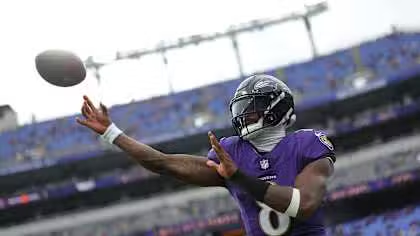
On November 23rd, 2025, the Baltimore Ravens hosted the New York Jets at M&T Bank Stadium in their first home game in nearly a month. This matchup represented a crucial opportunity for the Ravens to build on their recent momentum and push above .500 for the first time all season. The game ended in a 23-10 victory for Baltimore, marking their fifth consecutive win and improving their record to 6-5. While the final score suggested a comfortable margin, the performance was far from dominant, with the Ravens once again grinding out a victory against a struggling opponent rather than delivering the kind of explosive performance their talent suggests they’re capable of.
The Jets, limping into Baltimore with a 2-9 record and their 10th straight losing season already guaranteed, showed surprising fight behind 36-year-old journeyman quarterback Tyrod Taylor. For much of the game, New York hung around, taking a 7-3 halftime lead and threatening to pull off an upset before Baltimore’s defense made the plays necessary to preserve the victory. For the Ravens, it was another in a series of workmanlike wins that have characterized their November resurgence – games that haven’t always been pretty but have gotten them back into playoff contention after their disastrous 1-5 start to the season.
The victory also marked the Ravens’ return to first place in the AFC North, as Pittsburgh’s loss to Chicago left Baltimore in a tie with the Steelers atop the division. But questions remain about whether this team can elevate its play when facing better competition, as their recent winning streak has come exclusively against the league’s bottom-feeders.
Before we go further, visit our Baltimore Ravens portal for discounted parking, hotels and Ravens events around the neighborhood. You have more discounted parking options with us for your next Ravens games!
The Order of Ravens Play
The game opened with both teams feeling each other out in what became a scoreless first quarter. Baltimore’s offense, which had been explosive at times during the season, managed only two first downs on their first three possessions. Lamar Jackson, dealing with lingering knee and ankle issues that had limited his practice time during the week, didn’t look as mobile or dynamic as usual. The Ravens’ vaunted running game, led by Derrick Henry, was stymied early by a Jets defensive front that had shown glimpses of competitiveness despite their poor record.
New York’s offense, directed by Tyrod Taylor in just his 17th start over the past eight seasons, found slightly more success. Taylor, making his return to Baltimore where he was drafted by the Ravens in the sixth round back in 2011, showed the poise and experience that had kept him employed in the NFL for 15 seasons. The Jets mixed short passes with timely runs, keeping the Ravens’ defense honest and setting up manageable third downs.
The first points of the game came late in the second quarter when the Ravens’ offense finally got into field goal range. Tyler Loop, Baltimore’s reliable kicker, connected from 31 yards out to give the Ravens a 3-0 lead. But the Jets responded immediately with the game’s first touchdown drive.
Facing third-and-10 from the Baltimore 13-yard line, Taylor delivered a perfectly placed pass to wide receiver John Metchie III, who made an impressive diving catch at the pylon for a touchdown. It was Metchie’s second consecutive game with a touchdown since being acquired in a trade from Philadelphia, and his performance continued to provide a spark for an otherwise anemic Jets offense. The touchdown gave New York a stunning 7-3 lead with minutes remaining in the half.
The Jets took that 7-3 advantage into the locker room, marking their first halftime lead since the season opener against Pittsburgh. For Baltimore, it was a concerning performance – they had been held to just 72 net yards of offense in the first half, their lowest output in any first half all season. The offense was 0-for-5 on third down, and the much-hyped running game had been completely neutralized. Jackson had completed just 5 of 11 passes for 51 yards, and Henry had been limited to only 14 rushing yards. The home crowd that had been so loud and supportive in recent weeks grew nervous as the Ravens trudged off the field trailing an inferior opponent.
The second half, however, told a dramatically different story. Baltimore emerged from the locker room with renewed purpose and physicality, immediately asserting their will on both sides of the ball. The Ravens’ opening drive of the third quarter was a statement of intent – an 11-play, 74-yard march that consumed over six minutes of clock and showcased the kind of smashmouth football that had defined their best performances all season.
The drive appeared headed for a three-and-out when the Jets were flagged for pass interference on third-and-15, a controversial call that gave Baltimore a 34-yard gain and new life. The Ravens capitalized on the opportunity, pounding the ball with Henry on consecutive carries before the powerful running back bulled his way into the end zone from two yards out on third-and-goal. The touchdown gave Baltimore a 10-7 lead, their first advantage of the game, and the momentum had completely shifted.
The Jets’ offense, which had shown promise in the first half, suddenly went cold. On their next possession, facing fourth-and-2 from their own 42-yard line, Jets head coach Aaron Glenn made the aggressive decision to go for it rather than punt. It was a calculated risk from a first-year coach trying to keep his undermanned team competitive. Taylor’s pass sailed incomplete, and the Ravens took over in excellent field position.
Baltimore wasted no time capitalizing on the turnover on downs. Another pass interference penalty, this time on Jets safety Tony Adams on third down, gave the Ravens the ball at the 3-yard line. From there, Henry took a handoff and followed a devastating block from fullback Patrick Ricard into the end zone for his second touchdown of the day. The score came on consecutive drives lasting less than six minutes combined, and Baltimore suddenly held a commanding 17-7 lead early in the third quarter.
The Jets, to their credit, refused to fold. Nick Folk, who had remained perfect on field goal attempts all season, connected from 42 yards out early in the fourth quarter to cut the deficit to 17-10. With 14 minutes remaining and needing just one more score to tie the game, New York appeared to have life.
Then came the sequence that would define the game and exemplify both the Ravens’ resilient defense and the Jets’ season-long struggles. After the field goal, New York got the ball back and immediately began to move it effectively through the air. Running back Breece Hall, who had been a bright spot for the Jets all season, caught a short pass from Taylor and turned it into a spectacular 40-yard gain, spinning away from one defender and showing the burst that had made him one of the league’s most talented young backs. Hall followed that with another 15-yard reception, and suddenly the Jets were knocking on the door at the Baltimore 13-yard line.
The Ravens’ defense stiffened, forcing the Jets to convert multiple third downs just to keep the drive alive. Finally, with the ball inside the five-yard line and a chance to tie the game at 17-17, Hall took a handoff and bounced to the right, looking for the corner of the end zone. He fought through initial contact and appeared to be churning forward when Ravens cornerback Marlon Humphrey, returning from a finger injury that had sidelined him the previous week, attacked the ball with both hands. Humphrey ripped at the football as Hall continued to fight for yardage, and at the four-yard line, with Hall’s body turned around facing away from the end zone, the ball finally came loose. Safety Alohi Gilman pounced on it at the three-yard line, and Baltimore had survived.
It was the play of the game – a crushing turnover that snuffed out the Jets’ comeback attempt and preserved Baltimore’s lead. Hall, who had otherwise enjoyed an excellent performance with 119 total scrimmage yards, was inconsolable on the sideline after the fumble. Jets coach Aaron Glenn was seen putting his arm around his running back, offering words of encouragement despite the devastating mistake.
The Ravens added a Tyler Loop field goal with just over three minutes remaining to push the lead to 20-10, and when the Jets got the ball back for one final desperation drive, T.J. Tampa intercepted Taylor to seal Baltimore’s fifth consecutive victory. The final score of 23-10 flattered the Ravens somewhat, as the game had been competitive and in doubt until Humphrey’s crucial forced fumble.
Game Heroes
Derrick Henry: Henry’s stat line – 21 carries for 64 yards and two touchdowns – won’t make any highlight reels, but his performance was exactly what the Ravens needed in a grinding, physical game. After being held to just 14 yards in the first half, Henry wore down the Jets’ defensive front in the second half, consistently gaining tough yards between the tackles and converting short-yardage situations. His two third-quarter touchdowns, both from two yards out, were textbook power running – following Ricard’s lead blocking and refusing to be denied at the goal line. The performance also had historical significance: it was Henry’s 30th career game with multiple rushing touchdowns, tying him with Emmitt Smith for third-most in NFL history behind only LaDainian Tomlinson. With the 64 yards gained, Henry also passed Hall of Famers Marcus Allen, Edgerrin James, and Marshall Faulk on the NFL’s all-time rushing list, moving up to 13th with 12,294 career yards. At 31 years old, Henry continues to defy aging curves for running backs, and his ability to deliver in crucial moments remains one of Baltimore’s most valuable assets. He also added two catches for 24 yards, showing his evolving role as a receiver.
Lamar Jackson: Jackson’s numbers – 13 of 23 for 153 yards with no touchdowns and no interceptions – represented his third consecutive game with fewer than 200 passing yards, a concerning trend for the two-time MVP. Jackson clearly wasn’t himself, limited by the knee and ankle issues that had affected his practice availability. He ran just seven times for 11 yards, a stark contrast to the explosive running ability that had defined his career. Despite the modest statistics, Jackson made the throws he needed to make, particularly on third downs during Baltimore’s crucial second-half drives. He avoided turnovers, managed the game effectively, and showed the veteran presence necessary to guide his team through a sluggish performance. The concerning part for Baltimore is that this level of play won’t be sufficient against better competition. Jackson’s health and mobility will be critical factors as the Ravens enter a difficult stretch of their schedule with divisional games looming.
Marlon Humphrey: The veteran cornerback was the defensive hero, returning from his finger injury to play all 59 defensive snaps and make the game’s biggest play. Humphrey’s strip of Breece Hall at the goal line was a textbook example of ball-hawking technique – attacking the football when the runner was most vulnerable and refusing to give up on the play even as Hall fought for extra yardage. It was Humphrey’s first forced fumble of the season and a reminder of his playmaking ability when healthy. After a mixed-bag 2025 season marked by injuries and inconsistent play, Humphrey answered critics with one of his finest performances. His ability to stay healthy down the stretch could be the difference between the Ravens making a deep playoff run or exiting early.
Tyrod Taylor (Jets): The 36-year-old journeyman gave the Jets a chance to win, completing 17 of 28 passes for 222 yards and a touchdown against the team that drafted him 14 years earlier. Taylor showed the poise and experience that had kept him employed for a decade and a half, making smart decisions with the football and using his mobility effectively when protection broke down. He also added 31 rushing yards, including several scrambles that extended drives. While the interception late will go down as a blemish, Taylor played well enough to win and gave Baltimore’s defense fits for most of the afternoon. His performance was a reminder that experience and game management can compensate for declining physical tools.
Breece Hall (Jets): Hall’s performance will forever be defined by the fumble, but his overall game was excellent. He rushed for 44 yards on 16 carries and caught four passes for 75 yards, showcasing the dual-threat ability that makes him one of the league’s most talented young running backs. His 40-yard reception on the Jets’ final scoring threat was a highlight-reel play that demonstrated his vision, quickness, and elusiveness in space. Hall’s ability to cut back against pursuing defenders and turn short passes into explosive gains kept the Jets competitive all afternoon. The fumble at the goal line, stripped by Humphrey, will haunt him, but his teammates and coaches made clear their continued faith in their franchise back. For a player who had emphasized ball security all season and fumbled just once previously, the timing couldn’t have been worse.
Jordan Stout: The Ravens’ punter had a career day that deserves recognition. His 74-yard punt in the first half tied Sam Koch’s franchise record and backed the Jets up at their own 25-yard line at a crucial moment. Later, with the game still in doubt, Stout unleashed a 67-yard bomb that pinned New York at their own five-yard line with just over three minutes remaining, essentially ending the Jets’ comeback hopes. His grin on the sideline after the punt showed the joy of a specialist who knows he made a critical contribution. Stout’s booming leg has been one of Baltimore’s most pleasant surprises this season, and his field position battle won the hidden yardage game that often determines close contests.
Dre’Mont Jones: The Ravens’ trade deadline acquisition continued to pay dividends with 1.5 sacks and four tackles, including his first sack as a Raven in the second half. Jones’ pressure on Taylor forced an incompletion on third down, leading to a punt that shifted momentum. He also batted down a pass at the line of scrimmage, showing the versatility that made him such an attractive acquisition. Jones’ impact has been felt immediately, providing the kind of interior pass rush that had been missing from Baltimore’s defensive front all season.
What Worked and What Didn’t: In-depth Game Analysis
The Ravens’ offensive performance was concerning despite the victory. Holding a lead at home against a 2-9 team should be routine for a playoff-caliber squad, but Baltimore made it difficult with another sluggish start and extended stretches of ineffectiveness. The first-half output of 72 yards was alarming, as was the 0-for-5 performance on third down. Lamar Jackson’s limited mobility, whether due to injury management or the Jets’ defensive scheme, eliminated much of the dynamism that makes Baltimore’s offense so dangerous. When Jackson can’t threaten defenses with his legs, the entire offensive structure becomes more predictable and easier to defend.
The offensive line had mixed results. Ronnie Stanley and the tackles provided adequate pass protection, though Jackson was hurried on several occasions. The interior line, with Tyler Linderbaum anchoring at center, created enough push in the running game during the second half to allow Henry to wear down the Jets’ defense, but the struggles in the first half suggested that better defensive fronts could create significant problems. The concerning trend is Baltimore’s inability to establish the running game early – Henry had just 14 yards in the first half before finishing with 64 total. That’s not the kind of dominant ground attack that characterized their best performances earlier in the season.
The receiving corps was largely a non-factor in this game. Zay Flowers, who had been one of Jackson’s most reliable targets, was quiet. DeAndre Hopkins, the veteran acquisition who had provided occasional sparks, managed just one catch. Mark Andrews was targeted but couldn’t generate the explosive plays that had defined his career. The lack of a consistent passing attack made Baltimore one-dimensional in stretches, and against better defenses, that predictability will be exploited ruthlessly.
Red zone efficiency was perfect – two trips, two touchdowns – but both scores were short-yardage Henry plunges rather than the kind of diverse play-calling that suggests a creative, adaptable offense. While it’s never wrong to score touchdowns, the Ravens’ narrow range of successful plays in scoring position is a concern heading into tougher matchups.
Defensively, Baltimore showed resilience without dominance. The Ravens held the Jets to just 282 total yards and forced two turnovers, extending their impressive stretch of six consecutive games holding opponents under 20 points. The pass rush, bolstered by Jones’ arrival, generated enough pressure to make Taylor uncomfortable, though the veteran quarterback still found ways to extend plays and convert crucial third downs for much of the afternoon.
The secondary, led by Humphrey’s return, was solid but not spectacular. Nate Wiggins, who has developed into a reliable starter, went the full distance alongside Humphrey, while Chidobe Awuzie saw his snaps reduced to 23 as the Ravens managed their veteran’s workload. Kyle Hamilton, the dynamic safety, hobbled off with an apparent foot issue in the fourth quarter, though coach John Harbaugh indicated afterward that it wasn’t serious. Hamilton’s health is critical to Baltimore’s defense, as his versatility allows defensive coordinator Zach Orr to deploy more aggressive schemes.
The run defense, which had been a glaring weakness early in the season, has improved significantly during the winning streak. The Jets managed just 78 rushing yards on 27 carries, a meager 2.9 yards per attempt. Baltimore’s defensive front, featuring Taven Bryan (who left with an injury), Justin Madubuike, and the newly acquired Jones, has begun to establish a physicality that had been missing during the 1-5 start. Roquan Smith remains the heart of the unit, flying to the ball and setting the tone with his tackling intensity.
Special teams were once again excellent. Loop was perfect on three field goal attempts (31, 42, and an unlisted third), while Stout’s punting excellence has been documented. Coverage units were disciplined, and the Jets never threatened in the return game. It’s a small advantage, but in close games, special teams excellence provides the margin between victory and defeat.
The Jets’ game plan was sound for most of the afternoon. Aaron Glenn’s decision to go for it on fourth-and-2 was defensible given his team’s deficit in talent, and Taylor executed the short-to-intermediate passing game effectively enough to keep the Ravens’ defense honest. The pass interference penalties that extended Baltimore’s scoring drives were controversial – Glenn expressed frustration with the officiating afterward – and without those flags, the game’s complexion might have been different.
New York’s biggest mistake was the fumble, obviously, but Hall can’t be blamed for effort. He was fighting for yards, trying to score the touchdown that would tie the game, and Humphrey simply made a better play on the ball. The Jets’ 2-9 record reflects their lack of talent more than their effort or coaching, and they played competitively for three quarters before the depth differential became too much to overcome.
Moving Forward
The Ravens’ 6-5 record represents a remarkable turnaround from their 1-5 start, but the manner of their recent victories raises questions about their ceiling. Five straight wins is impressive regardless of opponent quality, but Baltimore hasn’t faced a team with a winning record since their surge began. They’ve beaten Chicago (4-7), Miami (5-6), Minnesota (4-7 when they played), Cleveland (3-8), and now the Jets (2-9). While you can only play who’s on your schedule, and winning games you’re supposed to win is a sign of a good team, the lack of statement victories leaves doubts about Baltimore’s ability to compete with the elite.
The health of Lamar Jackson is paramount. His three-game stretch of sub-200-yard passing performances and limited rushing attempts suggest he’s playing through pain. The Ravens have been cautious with his practice availability, holding him out of certain drills to manage his knee and ankle issues. With a Thursday night game against Cincinnati looming, Jackson won’t have much time to recover, and the short week could exacerbate his limitations. Baltimore’s Super Bowl aspirations are entirely dependent on Jackson’s health and mobility – when he’s compromised, the offense loses the explosive dimension that makes it nearly impossible to defend.
Derrick Henry’s historical accomplishments continue to mount, but his efficiency has declined from last season’s remarkable 5.9 yards per carry to 4.7 this year (through 11 games). At 31 years old and with a career-high workload, some regression is natural, but the Ravens need his production to remain high as they enter the most critical stretch of their season. His touchdown efficiency – nine scores on 187 carries – remains excellent, and his ability to convert short-yardage situations is invaluable. The question is whether he can maintain this level through December and potentially into January playoff football.
The defensive improvement has been real and significant. After allowing 146.4 rushing yards per game through five weeks and ranking 32nd in defensive rush EPA, Baltimore is now allowing just 96.6 yards per game on the ground and ranks third in that same metric. The transformation has been dramatic, though again, the quality of opponent must be considered. When the Ravens face Derrick Henry-caliber backs or elite rushing attacks in the playoffs, will this improvement hold up?
The schedule ahead presents both opportunity and challenge. The Thursday night game against Cincinnati (3-8) should be winnable despite the quick turnaround. That’s followed by the divisional gauntlet – games against Pittsburgh, at Pittsburgh again, and Cleveland to close the regular season. The Ravens control their own destiny in the AFC North race, sitting in a tie with the Steelers at 6-5, but they’ll need to prove they can beat quality opponents to claim the division title.
The broader playoff picture is more complicated. Baltimore currently holds a wild card position, but the AFC is tightly bunched, and every game matters in the race for postseason positioning. The Ravens’ goal isn’t just to make the playoffs – it’s to secure home-field advantage or at minimum a top-four seed that provides a home playoff game. That will require not just winning the games they should win, but beating the Steelers in head-to-head matchups and potentially claiming the division outright.
The questions that defined Baltimore’s season remain unanswered. Can Lamar Jackson stay healthy and return to his MVP-level form? Can the defense maintain its improvement when facing elite offenses? Can the offensive line provide consistent protection and create running lanes against better defensive fronts? Can the Ravens beat good teams in close games, or will the clutch-time execution issues that have plagued them continue?
For now, Baltimore can celebrate climbing back to .500 and reclaiming a share of first place in the AFC North. They’ve shown resilience, character, and the ability to win when not playing their best football. But the championship-caliber teams don’t just beat the Jets and Browns of the world – they dominate them. The Ravens are surviving and advancing, which is better than the alternative, but true contenders make statements. Until Baltimore proves it can beat winning teams with consistency, the doubts will linger.
The talent is undeniable. The pieces are in place. The schedule has provided an opportunity to build momentum and confidence. Now comes the time when good teams become great teams, when potential transforms into performance, and when the Ravens will discover whether this season ends in triumph or another disappointing early playoff exit. The margin between success and failure is razor-thin, and every play – every fumble forced, every yard gained, every decision made – carries enormous weight.
For Ravens fans, hope springs eternal. The five-game winning streak has them dreaming of January football at M&T Bank Stadium and another run at the Lombardi Trophy. But until Jackson looks like Jackson, until the offense rediscovers its explosiveness, and until the defense proves it can stop elite opponents, those dreams remain just that – dreams waiting to be realized or another season of what might have been.